·
BASICS
·
15 min read

MARKETING LEAD
Two weeks ago I was in a part of a pitch practice room watching a new founder rehearse her investor deck for the fourth time that morning. The deck was good. The opener was "Hi everyone, thanks so much for the time, I know you're busy, so I'll try to keep this tight." She lost the imaginary room in the first six words, and she didn't know it.
Making a good presentation isn’t only about what you say during the most important parts but also how you set the stage for your audience from the very beginning.
A strong presentation opener is a 30-second hook for a live audience, used to stop the mental drift in the room, which is what determines whether the next 20 minutes get remembered or ignored.
I've built investor decks, sales decks, all-hands decks, keynote decks, and the occasional terrible internal update where nobody remembered what I said by lunch. The lesson has been the same across all of them. The opener is where the talk is won or lost, and almost everyone spends their prep time on slide seven instead of slide one. This guide is the version of that lesson I wish someone had handed me three years ago. Nine openers with word-for-word scripts, a decision table so you know which one fits your room, the mistakes that quietly kill credibility, and what to put on the first slide so the visual matches what you're saying out loud.
TL;DR: How to Start a Presentation
Key takeaway | What it means for you |
The first 30 seconds decide how the rest of the presentation is received | Design the opener like it's the whole pitch, because for half the room, it is |
A strong opening follows three beats: Hook → Credibility → Agenda | Skip any of the three and the audience either disengages, doubts you, or gets lost |
The best opener depends on the context, not the stakes | A sales pitch, a keynote, and a team standup each need a different opener even if the topic is the same |
Your first slide is part of the hook | If your opener says "imagine" but the slide shows a bullet-point agenda, the audience trusts the slide |
Avoid the apology, the agenda recap, and the long self-intro | These three openers train the audience to tune out before you've said anything worth hearing |
Why the First 60 Seconds of a Presentation Decide Everything
The first 60 seconds are the window where the audience decides if you're worth their attention. Everything after that gets filtered through the impression you set in that first minute.
A 2010 study at The Catholic University of America found that most lecture attendees stopped paying attention to a speaker roughly 30 seconds into the speech, referenced in Duarte's research on opening a talk. Half a minute. That's the runway you're working with. And this is in a setting where the audience showed up specifically to listen. In a sales meeting or an investor pitch, the bar is higher and the runway is shorter.
The second number worth knowing: Stanford marketing professor Jennifer Aaker's research on narrative persuasion, published through the Stanford VMware Women's Leadership Innovation Lab, shows that stories are remembered up to 22 times more than facts alone. That gap is not about charisma. It's about the opener. A story-led start creates a neural hook. An agenda-led start creates a to-do list the audience silently tunes out of.
Put those two findings together and you get the working rule I use: the audience will decide in 30 seconds, and they will remember whichever mode you led in. Effective presentation hooks are the bridge between those two facts. Knowing how to open a presentation well is not about memorizing one magic line. It's about answering the audience's unspoken question in the first 10 seconds: "Why should I listen to you right now?"
How to Begin a Presentation: The Three-Part Opening Structure
You begin a presentation with a hook that earns attention, a credibility line that tells them why you, and an agenda that tells them what they're about to get. In that order. Every time.
Hook. First 20 to 30 seconds. Specific, concrete, unexpected. Not "thank you." Not your name. Not the title of your deck.
Credibility. 10 seconds. One sentence. Who you are and why you're the right person to talk about this. Not a biography. A reason.
Agenda. 15 seconds. What the next X minutes will deliver. Clear, numbered, skippable if the audience already bought in from the hook.
The order matters. Attention, trust, and context build on each other in that sequence. Credibility without a hook sounds like a LinkedIn intro read aloud. An agenda without credibility sounds like a syllabus. A hook without an agenda leaves the room guessing. That's the skeleton. The rest of how to start a presentation is picking the right type of hook for your situation.
A quick note before the opener list. Most of the advice you'll find online treats the nine openers below as interchangeable. They are not. The right opener is a function of the room, the stakes, and how much the audience already trusts you when you walk in. I'll get to that decision logic after you've seen what's in the toolkit.
9 Good Presentation Openers That Actually Work (With Scripts)
Below are nine good presentation openers that consistently earn attention. Each one comes with a scripted opening line you can adapt, a note on when it fits, and what to put on your first slide. A few of them I'd rank higher than the others, which I'll flag as we go.
1. The provocative question
Ask a question that forces the audience to think. Not one they can nod along to.
When to use it: Audiences that are actively skeptical or mentally half-checked-out. Workshops, internal presentations, conferences.
Script: "Show of hands: who here has sat through a pitch deck this month that you can actually remember? Keep your hand up if the product was memorable, not just the joke the founder opened with."
First slide: One sentence, centered. Nothing else.
The mistake most people make with this opener is asking a question the audience has a socially acceptable answer to. "Who wants to save money on cloud costs?" gets you polite silence. "Who here has sat through a pitch deck this month that you can actually remember?" gets you laughs, eye contact, and a room that's now paying attention.
2. The surprising statistic
Lead with a number that makes the audience blink. Make sure it's one they didn't already know.
When to use it: Data-literate rooms. Investor pitches, executive updates, research readouts.
Script: "The average adult attention span is now eight seconds. A goldfish gets nine. So my goal for this presentation is to help you beat the goldfish."
First slide: The number, big. Source, small.
This is the opener people most often get wrong by reaching for a stat that's too round or too famous. "90% of startups fail" gets a mental shrug because the audience has heard it a hundred times. The stat has to be specific enough that the audience thinks "wait, really?" before they think anything else.
3. The bold claim you'll defend
Make a statement that sounds like an opinion. Ideally one that goes against popular beliefs. Then spend the rest of the talk defending it.
When to use it: Thought leadership. Keynotes. When you want the audience to argue with you in their head for 20 minutes.
Script: "Pitch decks are the worst way to pitch a company. I say this as someone who's founded six successful start-ups."
First slide: The claim as a full sentence. No qualifiers.
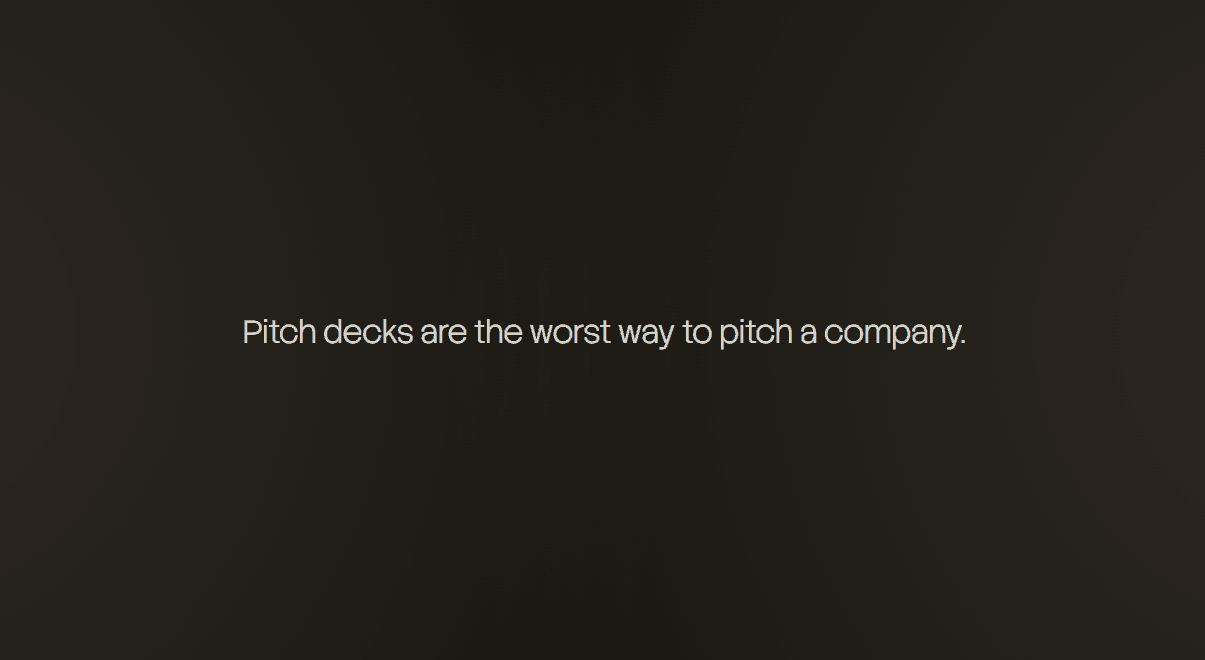
This is my personal favorite, and it's the one most speakers avoid because it feels risky. That's exactly why it works. A bold claim gives the audience a reason to listen, because they want to find out whether they agree with you. A safe claim gives them permission to zone out.
4. The 30-second story
Open with a tight, specific story that lands your main point before the audience knows it's the point.
When to use it: Almost anywhere. This is the default if you're not sure which opener fits.
Script: "Last Tuesday at 11pm, a founder I was prepping with was still rebuilding slide two of her investor deck. The meeting was at 9am. It was 30 minutes long. And she'd already invested eight hours on the deck. That's the problem I want to talk about."
First slide: A single image, a short quote or an impactful takeaway linking to the story. No bullets. Here’s an example of what I’d use for this script (random stat added for effect) :
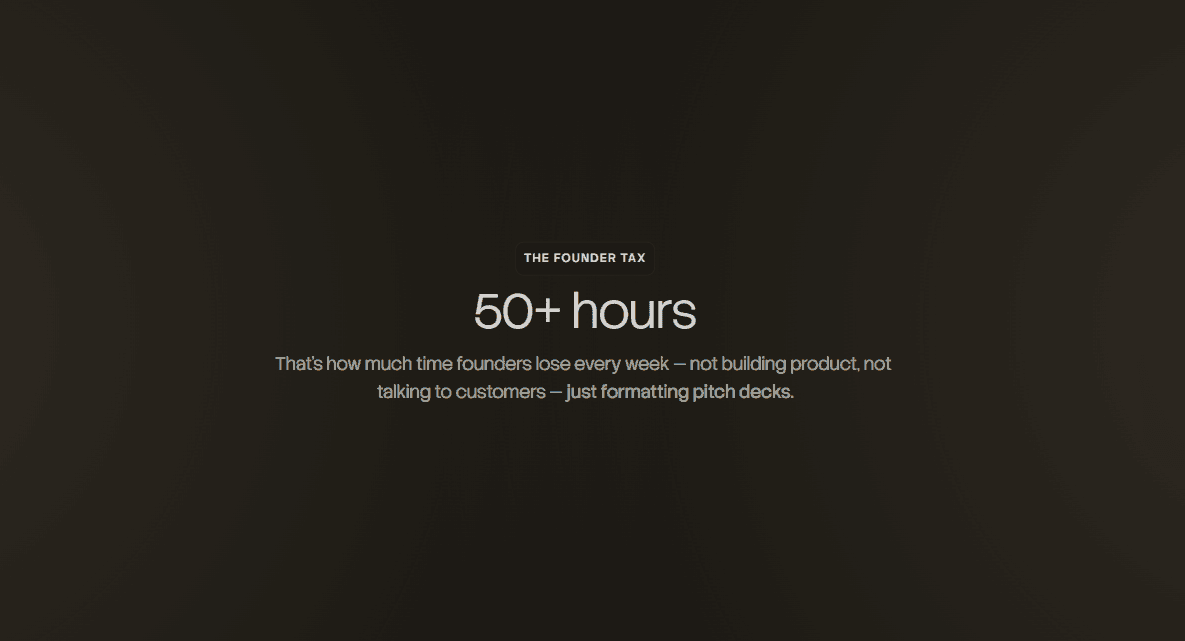
The reason this works is that a specific story forces the audience's brain into the same simulation you're in. "Last Tuesday at 11pm" is a different mental picture than "recently a founder." Fight for the specific detail.
5. The "imagine" scenario
Pull the audience into a hypothetical that puts them inside the problem before you name it.
When to use it: Sales presentations, training sessions, anywhere the audience benefits from feeling the pain first.
Script: "Imagine it's Sunday night. Your quarterly review is tomorrow at 9am. Your deck is a mess of screenshots and you're still rebuilding slide two."
First slide: The scene in one short phrase. A single visual if it genuinely helps.
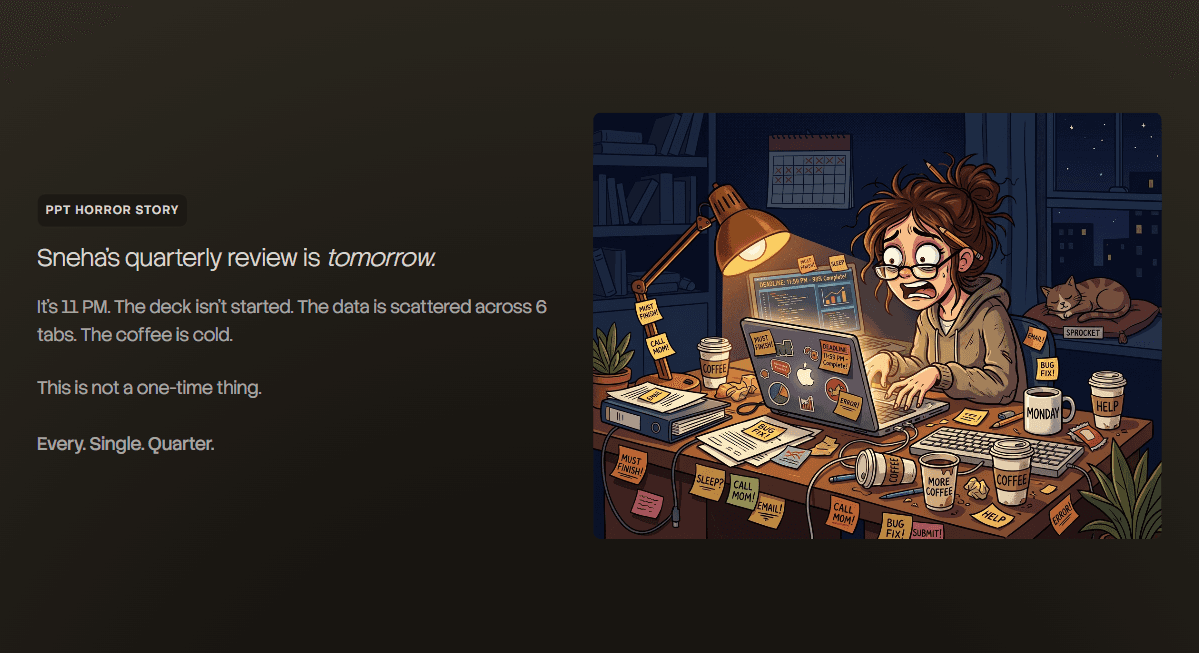
The "imagine" opener is a favorite of sales trainers for a reason. I love using humor for these openers if the product allows it - usually a funny example leaving the core ICP with a feeling of - “This is so me.”
6. The named-problem opener
State the audience's problem out loud in one sentence, so precisely that they lean in.
When to use it: Sales presentations, demo calls, B2B meetings where you've done your homework on the prospect.
Script: "Your team ships 10+ decks a week for client pitches, and last month one of them went out with the wrong quotes. That's why we're here."
First slide: The named problem, exactly as said.
This only works if you've actually done the research. A generic named-problem opener ("I know margin pressure is real right now...") sounds like a cold email read aloud. A specific one, with a detail only someone who did the work would know, is the strongest sales opener on this list.
7. The powerful quote
Here is where I'm going to disagree with almost every other article on this topic. Quotes are the most overrated opener in this entire list. They work about one time in five, and the other four times they make the speaker sound like they're reading a LinkedIn bio.
When to use it: Only when the quote is so relevant and so unexpected that removing it would damage the talk. If the quote is decorative, cut it and use a different opener.
First slide: The quote, the author, the year. Nothing else.
The test: if you can replace the quote with a different quote from a different author and the talk still works, you don't need the quote. Use the bold-claim opener instead.
8. The dramatic pause plus single word
Say one word. Then stop. Hold the silence for three full seconds.
When to use it: High-stakes keynotes where the room showed up specifically to hear you. Do not try this in a quarterly review.
Script: "Focus. [three-second pause] That's the one thing most presentations lose in the first minute. Let's talk about how to keep it."
First slide: The word. Alone. 200pt font.
The pause is the whole opener. If you can't commit to a real three-second silence, skip this one. A one-second pause reads as hesitation. A three-second pause reads as control. There's no middle ground.
9. The live poll or show of hands
Turn the audience from listeners into participants in the first 20 seconds.
When to use it: Interactive sessions, workshops, classroom presentations, webinar openers.
Script: "Raise your hand if you've ever rebuilt a slide the night before a meeting. Keep it up if you've done it more than three times this quarter."
First slide: The question. Nothing else.
The two-part version, where you ask a wide question first and then narrow it, works better than a single question. The first question gets everyone in. The second question signals exactly who the talk is aimed at, which pulls the right audience closer and gives the rest permission to listen less hard. Nobody's offended, everyone's oriented.
These are the top presentation openers worth knowing. The one you pick depends on the room.
How to Open a Presentation for Different Contexts
The best opener for a sales demo dies in a keynote. Here's how to match the opener to the context so you're not picking from a list in your head two minutes before you go on.
Context | Best openers | Skip these |
Sales presentation or demo call | Named-problem opener, surprising statistic, 30-second story, imagine scenario | Dramatic pause, powerful quote |
Investor pitch | Bold claim, surprising statistic, 30-second story | Live poll, dramatic pause |
Keynote or conference talk | Provocative question, dramatic pause, bold claim | Named-problem (too specific), live poll if the room is too big |
Internal team update or standup | 30-second story, named-problem opener, imagine scenario | Dramatic pause, powerful quote |
Classroom or teaching session | Live poll, provocative question, imagine scenario | Bold claim, dramatic pause |
Webinar | Live poll, surprising statistic, provocative question | Dramatic pause (dies on video) |
The table is rough, not absolute. Use it as a starting filter, not a rulebook. The real test when you're picking an opener is always the same: how much does this room already trust me when I walk in? High trust, you can take more risk (bold claim, dramatic pause). Low trust, earn it with specifics (named problem, surprising stat, 30-second story).
If you want to see how founders who raised built their opening slides, browse our pitch deck examples library.
Presentation Hooks to Avoid (The Openers That Kill Credibility)
The wrong hook doesn't just fail. It actively trains the audience to tune you out. I've made every one of these mistakes at least once, always with a stakeholder I wanted to impress. These are the presentation hooks I see most often, and they're the ones that result in awkward slilences and repeated yawns.
The apology. "Sorry, my voice is a bit off today, I was up late..." You just told the audience your talk is worse than it was going to be. Every sentence after lands against a lower bar. The variant I see most often in product demos is "Sorry, the staging environment is acting up, just give me a second..." which trains the client to doubt the product before they've seen it work.
The agenda recap. "Today I'm going to cover three things. First..." The audience doesn't need the map. They need a reason to take the trip. You can deliver the agenda in 15 seconds after the hook. Leading with it tells the audience nothing about why they should care.
The long self-intro. "My name is X, I've been at Y for Z years, I previously worked at A, B, and C..." Save it for slide two or a 10-second line after the hook. If your credibility is so load-bearing that it has to come first, you're in the wrong meeting.
Generic greetings stacked together. "Hello everyone, thanks so much for being here, hope you're all having a great day, before we get started..." Fifteen seconds. Zero information. The room has already decided.
The unrelated icebreaker joke. A joke that doesn't connect to the topic buys you three seconds of smiles and costs you all the credibility that follows. If the joke connects, use it. If it's just to warm the room up, cut it. Warm rooms come from strong content, not stand-up.
What to Put on Your First Slide (Because the Slide Is Part of the Opener)
Your opener is spoken, but the first slide is what the audience looks at while you speak. If the slide contradicts the words, the slide wins. Every time.
The first slide should show one idea, not three. If you open with a 30-second story, the slide is a single image or short quote. If you open with a stat, the slide is the number. If you open with a provocative question, the slide is the question. One idea per slide, especially the first.
This is where the craft gets harder than it looks. The right opening line is wasted if the slide behind it is a bulleted agenda. I've spent entire Saturday afternoons rebuilding a first slide because the template insisted on a title plus subtitle plus three bullets, and the opener I'd written ("Focus. [pause]") needed exactly one word on the screen. Most tools force a template, which pushes you toward generic openers, because the template does not know what you are saying out loud.
The practical rule is simple. Write the opening line first. Build the slide around it. Not the other way around. If you start with a template and try to make the opener fit, you will end up with the agenda slide and a room that’s lost interest within the first five seconds.
Key Takeaways
The first 60 seconds decide the rest of the presentation. Design the opener with the same care as the close.
Use the Hook → Credibility → Agenda structure. Skip any of the three and the room disengages.
Pick the opener that fits the context, not the one that fits your personality. Sales, keynote, classroom, and internal each need a different opener.
Your first slide is part of the hook. Build it around the spoken opener, not around a template.
Start Your Next Presentation With an Opener That Actually Lands
Knowing how to start a presentation is less about charisma and more about respect for the first 30 seconds. Pick your opener, script it, rehearse it, and build the first slide to match what you're saying out loud. Do that and you've already done more than 90% of the speakers the audience will sit through this quarter, which is how to make a presentation engaging before you've even gotten to the content.
If you're building a deck this week and the opening slide is the thing you keep rebuilding, try Alai. Give it your one-line hook, get four slide options back, and pick the one that actually matches the energy of how you plan to say it. That's the fastest way I know to turn a good opener into a first slide that earns the next 20 minutes.
FAQs
How do I start a PowerPoint presentation specifically?
PowerPoint is just the canvas. The opener logic is the same. Pick one of the nine openers above, match it to your context, and build your first slide as a single idea, not a templated agenda. PowerPoint's default templates push you toward a title-subtitle-bullets layout that kills most openers. Override it by deleting the placeholders and starting from a blank slide.
How long should the opening of a presentation be?
The opening should run 60 to 90 seconds total. Roughly 30 seconds for the hook, 10 for credibility, 20 for the agenda. Anything longer and you lose the momentum you earned in the first line. Anything shorter and the audience doesn't know what they're about to get. For a 10-minute internal update, halve those numbers. For a 45-minute keynote, do not double them. 90 seconds is the ceiling.
How should I start a sales presentation?
Start a sales presentation with the prospect's specific pain, named in one sentence. Not your agenda. Not your company intro. Something like "Your team is shipping four client decks a week and one went out last month with an outdated pricing slide." You've already done the discovery work. Use it. For deeper sales-deck opening logic, the best AI sales deck maker guide covers this in context.
Should I introduce myself first or hook first?
Hook first. Every time. The audience cares who you are only after they've decided you're worth listening to. A 10-second credibility line after the hook is plenty. Save the full bio for slide two or your speaker bio card. The one exception is if someone else is introducing you. In that case they've handled the credibility layer and you can go straight into the hook.
What's a good presentation opener example I can steal right now?
Here's one that works for most B2B topics: "Most presentations die in the first 30 seconds, and the speaker never knows it. That's what today is about, the 30 seconds you've been ignoring." It's a bold claim plus a reframe plus a subtle agenda in two sentences. Adapt the subject to your topic. Pair it with a single-sentence slide. For pitch-deck-specific opener examples, our pitch deck examples library has real decks you can study from companies that closed their rounds.
SEITEN
Werkzeuge vergleichen
Ressourcen