·
CASE STUDY
·
11 min read

Founder, Alai
Most pitch deck examples you’ll find online are from 2009 to 2018. Airbnb’s deck is everywhere. Uber’s original slides have been dissected a thousand times. Buffer’s transparent fundraising deck still gets shared.
Here’s the problem: those decks were built for a different era. Pre-COVID growth-at-all-costs markets. Zero interest rates. Investors who’d fund a napkin sketch.
The fundraising environment in 2024 and 2025 looks nothing like that. Investors spend more time on traction slides. They want to see a clear path to profitability. They expect a well crafted pitch deck that answers their questions before they ask them.
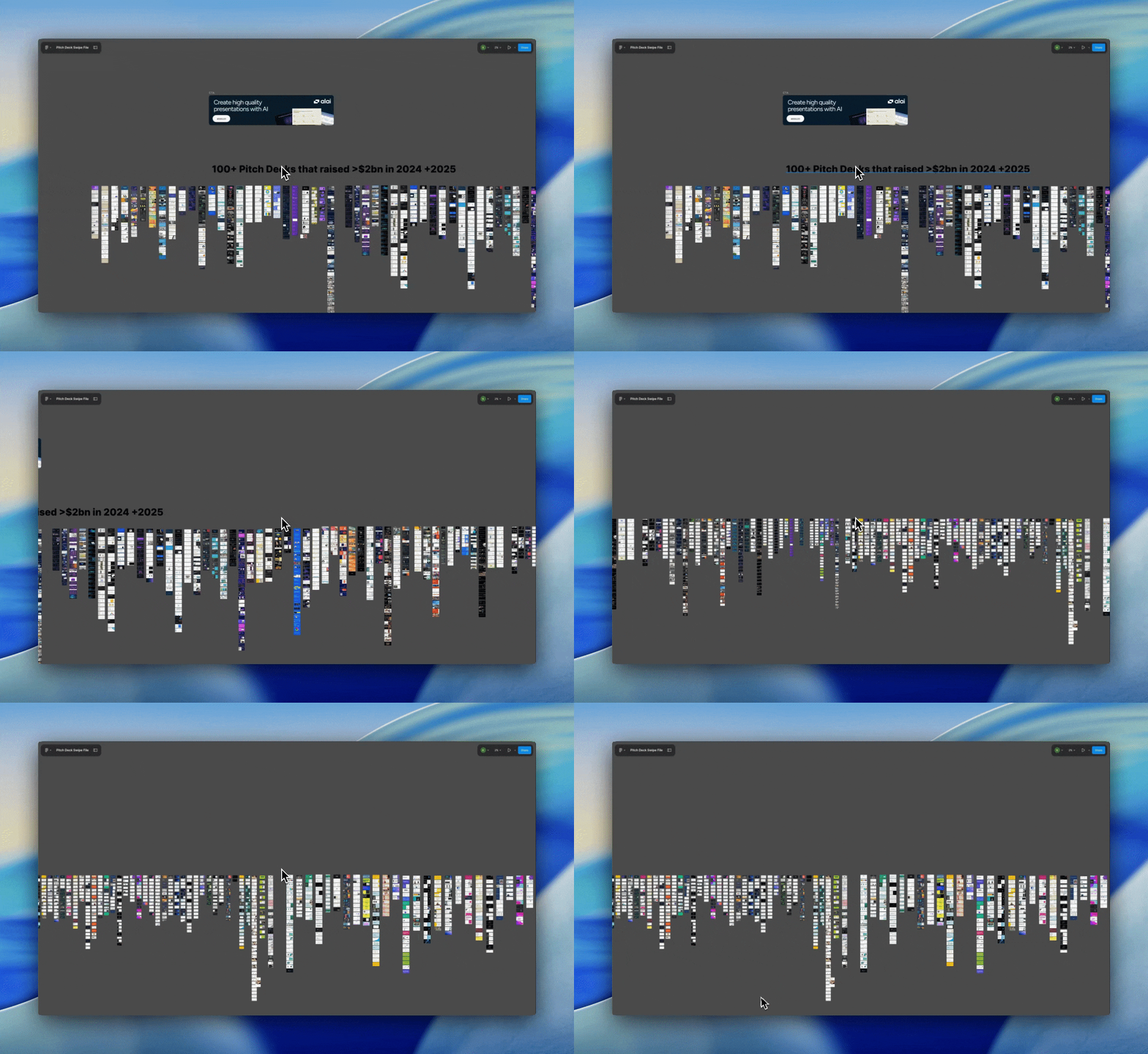
That’s why I put together a resource with 100+ real pitch deck examples from startups that actually closed rounds in the last 18 months. Together, these decks raised more than $2 billion. And you can browse them all right now.
Start here: 100+ real pitch deck examples (raised $2B+ in 2024–2025)
Open the Pitch Deck Swipe File in Figma →
Here’s what’s inside the file:
Stages covered: Pre-seed, seed, Series A, Series B, and Series C decks
Sectors represented: Fintech, AI/ML, SaaS, marketplace, climate tech, consumer apps, healthcare, logistics, and more
Geographies: US, Europe, LATAM, and APAC startups
Time period: Rounds closed between January 2024 and early 2025
Format: Real fundraising decks (not just pretty templates or concept designs)
Amounts raised: Individual rounds ranging from $500K pre-seed to $50M+ growth rounds
Included companies are diverse and innovative, such as Krepling, Being Health, Ceezer, Forta, Big Happy, Adventr, Tapouts, DIIC Interatec, Shimmer, Robin, Allstar.gg, Neocarbon, Product Demo, Vizcab, PLN Pro League Network, Atrpos Health, Viable, Footprint, Tappa, Crosby Health, Arbol, Pilotdesk, Grasp, Rize Decarbonizing Rice Cultivation, Sobet, Auquan, Synthesia, Qventus, Ocean, Vapi, Jimini, ToggleAI, Matria, Tiun, Pruna AI, Deckmatch, Endeavor, Evertune, Finix, Genie AI, Inshur, OroraTech, Howbout, Suki, Tensorwave, Pie, Reducto, LiQuickStack, Skyfire, Apheros, Elise, Dstlry, Filmustage, Knime, Anterior, Flo, Revi, Look North World, Posh, Vitable, Thoughtful, Millions, Uncaged, Rohlik, LostIn, Creatio, Oakland Ballers, Zing AI Coach, Decagon, Constructor, Pyte, Shopmy, Slip, Synthara, Hype, July, Huma, Tala, Tracebit, Natcap, Gendo, Finbourne, Techwolf, Prewave, Light, Storyblok, Recap, Malibou, Apriora, Harborlab, Definely, Readai, Kasa, Lirvana Labs, Storiaverse, Twochairs, Qureight, Hive, Kaikaku, Validmind, Pelago, Metos, Lago, Punchup, Moonhub, Coverdash, Louisa, Georgiamune, Kevel, Zenapse, Gridcog, Rapidcanvas, Griffin, Fijoya, Atmoszero, Vibe, Filigran, Embarrassing Matter-Cure, Spektr, ViralMoment, Hakio, Monite, Rogo, Suma, Vocode, Ezra, Pennylane, Hims & Hers, Kyra, Huddle, Concrete4Change, TVScientific, Highway9, Reel, Soundsfun, Unfabled, ID5, and many more.
Many of these decks closed their rounds after Jan 2024 and are current with what investors expect to see right now. You’re not looking at historical artifacts—you’re looking at what worked last quarter.
Use this as a live swipe file. Skim through, screenshot specific slides (problem statements, traction charts, roadmap layouts), and adapt the structures that resonate with your own business.

Pitch deck examples by startup stage
The best pitch deck structure depends heavily on where you are in your company’s lifecycle. A pre-seed deck for a two-person team with an MVP looks nothing like a Series B deck from a 50-person company with $5M ARR.
This section breaks down what to study at each stage, with references to specific examples from the 2024–2025 swipe file.
Pre-seed deck examples
What to look for: Pre-seed decks emphasize vision, founder–market fit, and early product demos over revenue metrics. Most successful startups at this stage don’t have meaningful traction yet—and investors know that.
Examples from the swipe file:
Krepling raised $1.2M in March 2024, focusing on the problem of developer productivity and their unique insights.
Viable raised $800K in June 2024 with a vision-heavy deck featuring prototype demos.
Rize Decarbonizing Rice Cultivation raised $1.5M pre-seed in February 2024, with a strong “why us” narrative based on founders’ research.
Key patterns at pre-seed:
10–14 slides typical
Heavy emphasis on problem insight and founder credibility
Traction slide might show waitlist signups, LOIs, or pilot conversations
Financial projections are light (12-month runway focus, not 5-year models)
Seed deck examples
What to look for: Seed decks need to show initial traction—even if it’s early. Investors want to see that you’ve tested your hypothesis and something is working. MRR, active pilots, or strong engagement metrics become critical.
Examples from the swipe file:
Being Health raised $3.5M seed in February 2024, with a traction slide showing MRR growth and retention.
Synthesia raised $4M in May 2024, including logos of pilot customers and a path to $1M ARR slide.
Shimmer raised $2.5M in August 2024 with a strong go-to-market slide and CAC/LTV projections.
Key patterns at seed:
12–16 slides typical
Traction slides are mandatory
Business model slides get more concrete
Team slide includes key hires planned with funding
Series A deck examples
What to look for: At Series A, investors want proof that you’ve found product-market fit and can scale what’s working. Decks lean heavily on metrics: ARR, retention curves, unit economics, and operational efficiency.
Examples from the swipe file:
Robin raised $14M Series A in April 2024, with cohort analysis and gross margin improvements.
Finix raised $18M in October 2024, featuring a detailed competitive landscape matrix.
OroraTech raised $12M in January 2024, with a strong “use of funds” slide tied to hiring and GTM milestones.
Key patterns at Series A:
14–18 slides typical
Multiple traction slides (revenue, retention, engagement, efficiency)
Competition slide is more detailed, often with a 2x2 matrix
Clear connection between funding amount and next-stage milestones
Series B–C deck examples
What to look for: Later-stage decks focus on category leadership, sustainable unit economics, and path to profitability. These are about proving you can build a large, defensible business.
Examples from the swipe file:
Auquan raised $45M Series B in March 2024, emphasizing market timing and gross margin analysis.
Tala raised $32M Series B in July 2024, with focus on regulatory moats and international expansion.
Synthara raised Series C funding, highlighting sustainable unit economics and path to profitability.
Key patterns at Series B+:
16–20 slides typical
Unit economics slides are mandatory (CAC payback, LTV/CAC, contribution margin)
Market size arguments shift to “why we can dominate this category”
Board composition and governance often mentioned
Anatomy of a great pitch deck (slide-by-slide outline)
After studying dozens of examples, you need a practical checklist to build your own deck. Here’s the slide-by-slide structure that appears most consistently in successful 2024–2025 decks.
1. Cover slide: Show your logo, one-line value proposition, founding year, and current round. Example: “Acme Corp | AI-powered supply chain optimization | Founded 2022 | Raising $3M Seed, Q2 2025.” This immediately tells investors what they’re looking at.
2. Problem slide: 3–4 sharp bullets plus one bold data point. No dense paragraphs. Example format: “$47B wasted annually on X” as the headline, with 3 bullets explaining why this happens.
3. Solution slide: One clear statement of what you do, supported by 2–3 key benefits. Visual: product screenshot or simple diagram showing the core workflow.
4. Product slide: Showcase product’s key features with screenshots or a short demo. Focus on the “underlying magic”—what’s your competitive advantage that’s hard to replicate?
5. Market slide (TAM/SAM/SOM): Show market size and market opportunity with clear sources. Include a “why now” element: what timing factor makes this the right moment? Market trends, regulatory shifts, or technology changes.
6. Business model slides: Explain how you make money. Include pricing tiers, revenue streams, and unit economics if you have them. Be specific: “$99/month per seat” beats “SaaS model.”
7. Traction slide: This is where modern decks differ most from older ones. Include MRR/GMV charts (month-by-month), cohort retention curves, logos of paying customers, and key metrics. No vague “growing fast” statements.
8. Go-to-Market slide: How do you acquire customers? Show your target market, target audience, channels, and early evidence of what’s working. Include CAC if you have it.
9. Competition slide: Map the competitive landscape with a 2x2 matrix or feature comparison table. Show your unique selling points clearly. Don’t claim “no competition”—investors won’t believe you.
10. Team slide: Names, titles, photos, and one-line credentials. “Ex-Stripe, scaled risk models to 10M users” is better than “10 years of experience.” Include LinkedIn icons. A good team slide builds credibility fast.
11. Financials / Forecast slide: 3-year projections with key assumptions stated. Show financial projections for revenue, major expenses, and path to break-even. Later stages need more detail.
12. Roadmap slide: What will you accomplish in the next 12–18 months? Tie milestones to the funding you’re raising.
13. Ask & Use of Funds slide: State the exact amount: “Raising $3M Seed.” Include target close date: “Target close: Q2 2025.” Show spending buckets: Product 40%, GTM 40%, Ops 20%. This is where you secure funding by being specific.
14. Contact slide: Email, phone, LinkedIn. Make it easy for potential investors to reach you.
The 10/20/30 rule from Guy Kawasaki (10 slides, 20 minutes, 30-point font minimum) is still good guidance, even if most decks now run 12–16 slides.
Common mistakes we see
Many founders struggle with creating a pitch deck that truly stands out. Common mistakes include:
Generic headings that fail to capture attention or convey unique value
Too much content crammed into slides, overwhelming the audience
Lack of clarity in the messaging, leaving investors confused about the opportunity
Avoiding these pitfalls by using simple language, clear structure, and strong visuals can make a compelling case to potential investors.
How to create your pitch deck without design headaches
Once you have your compelling narrative and story figured out, the next step is turning that raw content into a visually stunning pitch deck. This is where many founders get stuck—overfitting to generic templates or struggling with design tools.
That’s why using a tool like Alai can be a game changer. Alai is the best place on the internet for founders to create high-quality pitch decks effortlessly. It takes your story and raw content and automatically converts it into a beautifully designed deck, ensuring your presentation makes a lasting impression without the need to wrestle with design.
By trusting Alai to handle the design, you avoid the trap of forcing your content into rigid templates and instead get a fully customizable, polished deck that highlights your market potential, team members, and unique selling points with strong visuals and minimal text. This allows you to focus on perfecting your business strategy and narrative while Alai ensures your pitch deck presentation looks professional and compelling.
How to use pitch deck examples without copying them
It’s tempting to copy a famous deck slide-for-slide. Don’t. Investors have seen that structure thousands of times, and they can spot clones immediately.
Instead, follow the “pattern, then personalize” approach:
Study patterns across many decks: Open the swipe file and pick 10 decks from companies at your stage and in your sector. Note which slides they all include. What do they skip? How much text do they use? This gives you the pitch deck template—not from one famous deck, but from a consensus of what works now.
Create your own comparison grid: For each of those 10 decks, write down:
Total slide count
Which slides are included/excluded
How they present traction (charts vs. bullets vs. logos)
Length of their ask slide
This exercise takes 30 minutes and gives you a solid grasp of current norms.
Adapt language to your own story: The biggest mistake founders make is using generic phrasing copied from famous decks. Your problem slide should use language your customers actually use. Your value proposition should reflect your own business, not a fill-in-the-blank template.
Sanity-check with people who know 2024–2025 markets: Before sending your deck to real investors, show it to 2–3 friendly operators or angels who’ve seen recent fundraising cycles. What worked in 2016 ICO decks or 2021 zero-rate markets may not work now. Get feedback from people operating in the current environment.
Use the swipe file as a design reference, not a script: The deck examples show you what level of visual appeal investors expect, how to lay out a traction slide, and how much white space to use. They’re not a source of specific claims, market size numbers, or business strategy language.
Your next step: Open the Pitch Deck Swipe File, pick 5 decks similar to your situation, and outline your own slides based on those patterns today.

FAQ: Common questions about pitch deck examples
What is a pitch deck? A pitch deck is a 10–20 slide presentation that summarizes a startup’s story—the problem, solution, market, traction, team, and funding ask. It’s primarily used to raise funding from investors, but variations exist for sales conversations, partnerships, and demo days.
How many slides should a pitch deck have in 2025? Most successful decks in the 2024–2025 swipe file have 12–16 slides for initial investor meetings. Pre-seed can go shorter (10–12), while Series A+ often runs 16–18. Guy Kawasaki’s classic advice of 10 slides is a good floor, not a ceiling.
Do investors still read decks in detail? Data from recent fundraising cycles shows investors skim first—often spending just 3–4 minutes on an initial review. They dive deeper only if interested. This means front-loading clarity on your cover slide, problem, solution, and traction is crucial. Grab attention early or lose it entirely.
Should I design before or after I finalize content? Always lock your content and narrative first using simple layouts. Once the story works, polish the design. Many founders waste weeks on visually appealing slides before their core argument is solid. Use the swipe file examples as visual inspiration only after your content is done.
Can I include a product demo video in my deck? Yes—some decks in the swipe file include embedded product demos or animated prototypes. These can be powerful for showing product’s key features. But they should supplement clear static slides, not replace them. Investors often review decks asynchronously in contexts where video won’t play.
Should I send my deck before or after a meeting? Both approaches work. Some investors prefer a quick overview of the deck before the call so they can prepare questions. Others prefer to see it live. Ask your contact for their preference. Either way, have a polished slide deck ready to share at their own pace after the conversation.
Related readings
Top 4 AI Pitch Deck Generators: Which Tool Actually Helps You Raise?
How to Create an Investor Pitch Deck That Gets You Funded (2025 Guide)
By integrating your compelling story with a tool like Alai, you can create a pitch deck that not only tells a compelling narrative but also delivers a well designed pitch deck presentation that makes a lasting impression on potential investors and partners alike.
PAGES
Compare Tools
resources